Today, Trinity Episcopal Church is spiritual home to a truly diverse community of faith, fully representative of our surrounding population. Our involvement in and with the community continues to grow and expand as our service and ministry to others increases. We are a friendly, welcoming parish, proud of our inclusiveness and hospitality.
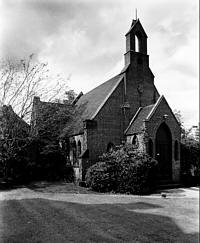
The current Trinity Episcopal Church building, at the end of Ryers Lane in Matawan, was built in 1968. It replaced our original church on Main Street, which is featured in "The New Jersey Churchscape." The old church, built in 1850, still stands, at 74 Main Street, Matawan, as Bart's Restaurant.
Of the old church building, Churchscape would later write: "This is an early English Gothic plan, modeled after St James the Less in Philadelphia, by Richard Upjohn, one of the leading architects in the country in the 1840s and 50s. The steep pitch to the roof, the very clearly delineated chancel, the bellcote, buttresses and low side walls as a means of encompassing the interior aisles were among the elements Upjohn borrowed from St James the Less. Upjohn created a number of plans for small parishes, sometimes charging as little as $100 for a set of plans."
Construction of the old church was initiated by Colonel John Travers, who lived at the mouth of the Cheesequake River in what was then Middletown Point. The cornerstone was laid on April 24, 1850, by the Rt. Rev. George W. Doane, Bishop of the Diocese of New Jersey. The Church was incorporated on May 11. 1850
In 1926, through the efforts of Senior Warden Clifford Chapman, Trinity became an assisted parish under the supervision of the Rev. John Schwacke, rector of St. Peter's Freehold. He served Trinity in this capacity until his death in 1942. Trinity was then put under the direction of the rector of St. Mary's Keyport, and remained so until 1953 when it was returned to the oversight of St. Peter's.
In 1958, Trinity Church started its first fund drive to purchase its own rectory and seek full parish status. The first rectory was on Wyckoff Street, where The Rev. John Robson resided as Trinity's first full-time Rector. When larger quarters were needed, a building was purchased at 142 Broad Street. At that time, Trinity obtained the services of a seminarian, Carroll B. Hall, who was later ordained a priest and succeeded Father Robson as Rector.
These and other priests who served Trinity during the 1940s and 1950s are remembered by former parishioner William G. Ratcliffe, who writes:
"I was baptized by Fr. Clayton in 1943. After him there was Fr. Arnold who was there in 1950. Fr. James Gusweller was at the church in the early 1950's. Fr. Gusweller also served at Church of Our Savior in Cheesequake and St. Mary's in Keyport at the same time. He went on to serve in various churches in New York City and became well known for his work there. I recall Fr. White who was with us for a while and also served at Cheesequake. For several years in the mid '50's Fr. Bernard Garlick was our rector in addition to being rector at St. Peter's in Freehold. I was confirmed there in 1956.
“I believe Fr. John Robson was the first full-time rector at Trinity. He was at the church in the late 1950's and lived in the first rectory on Wycoff Street (formerly the Hessey residence). Fr. Hall followed Fr. Robson and lived in the Broad Street rectory (formerly the Ritter residence)... I have many fond memories of the years at Trinity and remain grateful to the clergy and fine people there for providing a solid church foundation."
With the growth of Matawan and the surrounding area, it became increasingly clear that the old brick church building on Main Street could not long accommodate our expanding congregation. Plans were undertaken to find a location for a new and larger church building. A four-acre site at the end of Ryers Lane was purchased and ground was broken on October 8, 1967.
During this same period, The Rev. M. George Jaeger became our Rector. Bishop Banyard dedicated the new church building on June 18, 1968. The old church on Main Street was sold and has since become a restaurant.
Longtime parishioner Meredith Taylor recalls this period:
"My parents Bob and Jeanne Taylor moved to Matawan in 1962. We joined Trinity before moving here as we would visit our house under construction and then go to church. Trinity Church on Main St. was soon outgrown and we started having morning prayer services and church school down the street at the firehouse. We moved from Main Street to Ryers Lane around 1969, with services at the Ravine Drive school while the present church and rectory were constructed.
"The large arches which run throughout the church arrived on a huge truck upside down, looking much like Noah's Ark to my child's eye. The men of Trinity finished the inside of the church. They stained, laid the floors and did all the work that was not done by the builder. This was amazing to see. They also put the church rectory together as it was a modular home-- very rare in those days. It arrived in two large pieces and was placed over the basement and then attached to a two-car garage. Talk about team work!"
In 1979, Rev. Jaeger was succeeded by The Rev. Charles D. Ridge, who would lead Trinity into the busy decade of the 1980s. First, in 1980, new chairs were purchased for the Church. In 1985, a new organ was purchased through a fund drive which was so successful that a new piano was also acquired. The community was then invited to the organ dedication which featured a concert by renowned organist Carlo Curley.
In 1986, the Diocese of New Jersey celebrated its bicentennial with a celebration at the Garden State Arts Center in Holmdel. Trinity's Rector, Rev. Ridge, ably handled the complex logistics of celebrating the Eucharist with 5,000 people while members of the parish served as ushers and choir members.
At the annual picnic in 1988, the parish joyfully marked the passage of time by burning the church mortgage. Later that year, a new roof was put on the church building. The growth continued within the Church as a beautiful Columbarium was installed in the chapel, which was appropriately, renamed The Chapel of the Resurrection.
We look to the future with guidance from the Holy Spirit for direction that we may continue to be a community of faithful followers of Jesus Christ and a welcome place for all the community. New parishioners continue to arrive and longtime parishioners, as they move through the seasons of their lives, continue to appreciate the gift of Trinity.
Today Trinity is still the same great place it was. Yes, it has changed in many ways, but always remains that place where 'all are welcome' and always will be. 'How lovely is your dwelling place?' Ours is very lovely indeed."

